6.13. HTTP Keywords
Using the HTTP specific sticky buffers provides a way to efficiently inspect specific fields of the HTTP protocol. After specifying a sticky buffer in a rule it should be followed by one or more doc:payload-keywords.
Many of the sticky buffers have legacy variants in the older “content modifier” notation. See Modifier Keywords for more information. As a refresher:
‘sticky buffers’ are placed first and all keywords following it apply to that buffer, for instance:
alert http any any -> any any (http.response_line; content:"403 Forbidden"; sid:1;)
Sticky buffers apply to all “payload” keywords following it. E.g. content, isdataat, byte_test, pcre.
‘content modifiers’ look back in the rule, e.g.:
alert http any any -> any any (content:"index.php"; http_uri; sid:1;)
Content modifiers only apply to the preceding content keyword.
The following request keywords are available:
Keyword |
Legacy Content Modifier |
Direction |
|---|---|---|
http.uri |
http_uri |
Request |
http.uri.raw |
http_raw_uri |
Request |
http.method |
http_method |
Request |
http.request_line |
http_request_line (*) |
Request |
http.request_body |
http_client_body |
Request |
http.header |
http_header |
Both |
http.header.raw |
http_raw_header |
Both |
http.cookie |
http_cookie |
Both |
http.user_agent |
http_user_agent |
Request |
http.host |
http_host |
Request |
http.host.raw |
http_raw_host |
Request |
http.accept |
http_accept (*) |
Request |
http.accept_lang |
http_accept_lang (*) |
Request |
http.accept_enc |
http_accept_enc (*) |
Request |
http.referer |
http_referer (*) |
Request |
http.connection |
http_connection (*) |
Request |
http.content_type |
http_content_type (*) |
Both |
http.content_len |
http_content_len (*) |
Both |
http.start |
http_start (*) |
Both |
http.protocol |
http_protocol (*) |
Both |
http.header_names |
http_header_names (*) |
Both |
*) sticky buffer
The following response keywords are available:
Keyword |
Legacy Content Modifier |
Direction |
|---|---|---|
http.stat_msg |
http_stat_msg |
Response |
http.stat_code |
http_stat_code |
Response |
http.response_line |
http_response_line (*) |
Response |
http.header |
http_header |
Both |
http.header.raw |
http_raw_header |
Both |
http.cookie |
http_cookie |
Both |
http.response_body |
http_server_body |
Response |
http.server |
N/A |
Response |
http.location |
N/A |
Response |
file.data |
file_data (*) |
Response |
http.content_type |
http_content_type (*) |
Both |
http.content_len |
http_content_len (*) |
Both |
http.start |
http_start (*) |
Both |
http.protocol |
http_protocol (*) |
Both |
http.header_names |
http_header_names (*) |
Both |
*) sticky buffer
6.13.1. HTTP Primer
It is important to understand the structure of HTTP requests and responses. A simple example of a HTTP request and response follows:
HTTP request
GET /index.html HTTP/1.0\r\n
GET is the request method. Examples of methods are: GET, POST, PUT,
HEAD, etc. The URI path is /index.html and the HTTP version is
HTTP/1.0. Several HTTP versions have been used over the years; of
the versions 0.9, 1.0 and 1.1, 1.0 and 1.1 are the most commonly used
today.
Example request with keywords:
HTTP |
Keyword |
GET /index.html HTTP/1.1\r\n |
http.request_line |
Host: www.oisf.net\r\n |
http.header |
Cookie: <cookie data> |
http.cookie |
Example request with finer grained keywords:
HTTP |
Keyword |
GET /index.html HTTP/1.1\r\n |
http.method http.uri http.protocol |
Host: www.oisf.net\r\n User-Agent: Mozilla/5.0\r\n |
http.host |
http.user_agent |
|
Cookie: <cookie data> |
http.cookie |
HTTP response
HTTP/1.0 200 OK\r\n
<html>
<title> some page </title>
</HTML>
In this example, HTTP/1.0 is the HTTP version, 200 the response status code and OK the response status message.
Although cookies are sent in an HTTP header, you can not match on them
with the http.header keyword. Cookies are matched with their own
keyword, namely http.cookie.
Each part of the table belongs to a so-called buffer. The HTTP method belongs to the method buffer, HTTP headers to the header buffer etc. A buffer is a specific portion of the request or response that Suricata extracts in memory for inspection.
All previous described keywords can be used in combination with a
buffer in a signature. The keywords distance and within are
relative modifiers, so they may only be used within the same
buffer. You can not relate content matches against different buffers
with relative modifiers.
6.13.2. http.method
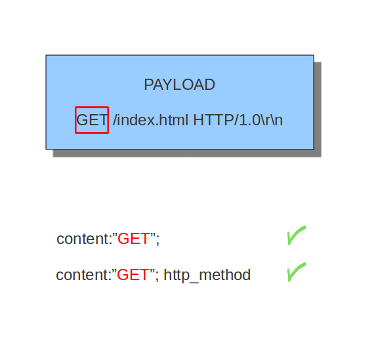
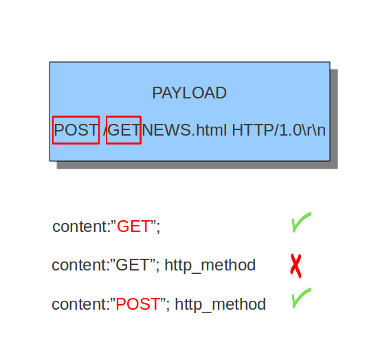
With the http.method content modifier, it is possible to match
specifically and only on the HTTP method buffer. The keyword can be
used in combination with all previously mentioned content modifiers
such as: depth, distance, offset, nocase and within.
Examples of methods are: GET, POST, PUT, HEAD, DELETE, TRACE, OPTIONS, CONNECT and PATCH.
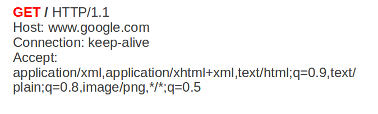
Example of a method in a HTTP request:
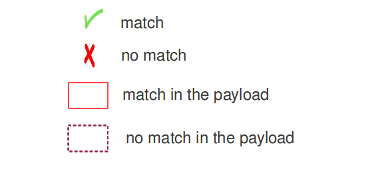
Example of the purpose of method:
6.13.3. http.uri and http.uri.raw
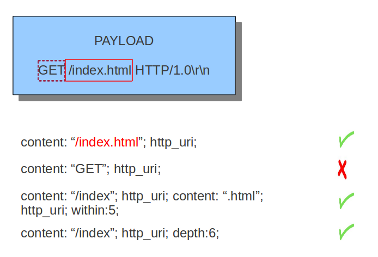
With the http.uri and the http.uri.raw content modifiers, it
is possible to match specifically and only on the request URI
buffer. The keyword can be used in combination with all previously
mentioned content modifiers like depth, distance, offset,
nocase and within.
The uri has two appearances in Suricata: the uri.raw and the normalized uri. The space for example can be indicated with the heximal notation %20. To convert this notation in a space, means normalizing it. It is possible though to match specific on the characters %20 in a uri. This means matching on the uri.raw. The uri.raw and the normalized uri are separate buffers. So, the uri.raw inspects the uri.raw buffer and can not inspect the normalized buffer.
Note
uri.raw never has any spaces in it.
With this request line GET /uid=0(root) gid=0(root) HTTP/1.1,
the http.uri.raw will match /uid=0(root)
and http.protocol will match gid=0(root) HTTP/1.1
Reference: https://redmine.openinfosecfoundation.org/issues/2881
Example of the URI in a HTTP request:

Example of the purpose of http.uri:
6.13.4. uricontent
The uricontent keyword has the exact same effect as the
http.uri content modifier. uricontent is a deprecated
(although still supported) way to match specifically and only on the
request URI buffer.
Example of uricontent:
alert tcp $HOME_NET any -> $EXTERNAL_NET $HTTP_PORTS (msg:”ET TROJAN Possible Vundo Trojan Variant reporting to Controller”; flow:established,to_server; content:”POST “; depth:5; uricontent:”/frame.html?”; urilen: > 80; classtype:trojan-activity; reference:url,doc.emergingthreats.net/2009173; reference:url,www.emergingthreats.net/cgi-bin/cvsweb.cgi/sigs/VIRUS/TROJAN_Vundo; sid:2009173; rev:2;)
The difference between http.uri and uricontent is the syntax:
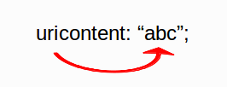
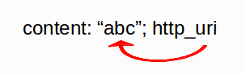
When authoring new rules, it is recommended that the http.uri
content sticky buffer be used rather than the deprecated uricontent
keyword.
6.13.5. urilen
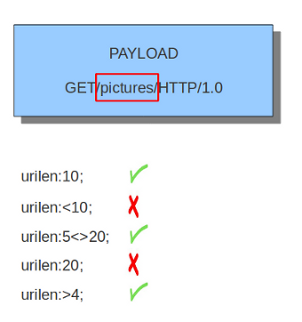
The urilen keyword is used to match on the length of the request
URI. It is possible to use the < and > operators, which
indicate respectively smaller than and larger than.
The format of urilen is:
urilen:3;
Other possibilities are:
urilen:1;
urilen:>1;
urilen:<10;
urilen:10<>20;        (bigger than 10, smaller than 20)
Example:
Example of urilen in a signature:
alert tcp $HOME_NET any -> $EXTERNAL_NET $HTTP_PORTS (msg:”ET TROJAN Possible Vundo Trojan Variant reporting to Controller”; flow:established,to_server; content:”POST “; depth:5; uricontent:”/frame.html?”; urilen: > 80; classtype:trojan-activity; reference:url,doc.emergingthreats.net/2009173; reference:url,www.emergingthreats.net/cgi-bin/cvsweb.cgi/sigs/VIRUS/TROJAN_Vundo; sid:2009173; rev:2;)
You can also append norm or raw to define what sort of buffer you want
to use (normalized or raw buffer).
6.13.6. http.protocol
The http.protocol inspects the protocol field from the HTTP request or
response line. If the request line is ‘GET / HTTP/1.0rn’, then this buffer
will contain ‘HTTP/1.0’.
Example:
alert http any any -> any any (flow:to_server; http.protocol; content:"HTTP/1.0"; sid:1;)
http.protocol replaces the previous keyword name: `http_protocol. You may continue
+to use the previous name, but it’s recommended that rules be converted to use
+the new name.
Example:
alert http any any -> any any (flow:to_server; http.protocol; content:"HTTP/1.0"; sid:1;)
6.13.7. http.request_line
The http.request_line forces the whole HTTP request line to be inspected.
Example:
alert http any any -> any any (http.request_line; content:"GET / HTTP/1.0"; sid:1;)
6.13.8. http.header and http.header.raw
With the http.header content modifier, it is possible to match
specifically and only on the HTTP header buffer. This contains all of
the extracted headers in a single buffer, except for those indicated
in the documentation that are not able to match by this buffer and
have their own content modifier (e.g. http.cookie). The modifier
can be used in combination with all previously mentioned content
modifiers, like depth, distance, offset, nocase and
within.
Note: the header buffer is normalized. Any trailing whitespace and tab characters are removed. See: https://lists.openinfosecfoundation.org/pipermail/oisf-users/2011-October/000935.html. If there are multiple values for the same header name, they are concatenated with a comma and space (”, “) between each of them. See RFC 2616 4.2 Message Headers. To avoid that, use the
http.header.rawkeyword.
Example of a header in a HTTP request:
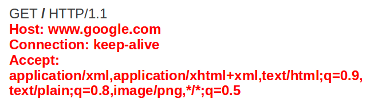
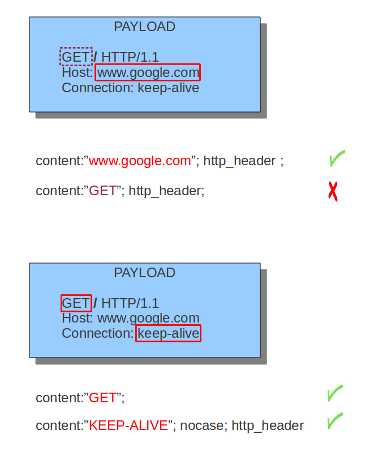
Example of the purpose of http.header:
6.13.9. http.cookie
With the http.cookie content modifier, it is possible to match
specifically and only on the cookie buffer. The keyword can be used in
combination with all previously mentioned content modifiers like
depth, distance, offset, nocase and within.
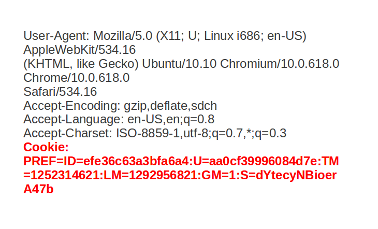
Note that cookies are passed in HTTP headers, but are extracted to a dedicated buffer and matched using their own specific content modifier.
Example of a cookie in a HTTP request:
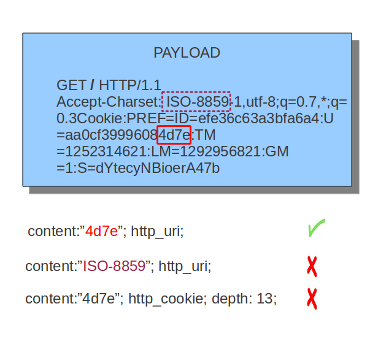
Example of the purpose of http.cookie:
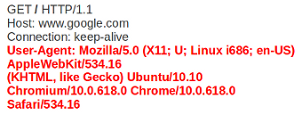
6.13.10. http.user_agent
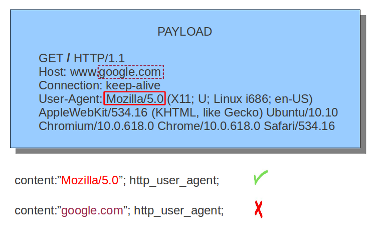
The http.user_agent content modifier is part of the HTTP request
header. It makes it possible to match specifically on the value of the
User-Agent header. It is normalized in the sense that it does not
include the _”User-Agent: “_ header name and separator, nor does it
contain the trailing carriage return and line feed (CRLF). The keyword
can be used in combination with all previously mentioned content
modifiers like depth, distance, offset, nocase and
within. Note that the pcre keyword can also inspect this
buffer when using the /V modifier.
Normalization: leading spaces are not part of this buffer. So
“User-Agent: rn” will result in an empty http.user_agent buffer.
Example of the User-Agent header in a HTTP request:
Example of the purpose of http.user_agent:
6.13.10.1. Notes
The
http.user_agentbuffer will NOT include the header name, colon, or leading whitespace. i.e. it will not include “User-Agent: “.The
http.user_agentbuffer does not include a CRLF (0x0D 0x0A) at the end. If you want to match the end of the buffer, use a relativeisdataator a PCRE (although PCRE will be worse on performance).If a request contains multiple “User-Agent” headers, the values will be concatenated in the
http.user_agentbuffer, in the order seen from top to bottom, with a comma and space (”, “) between each of them.Example request:
GET /test.html HTTP/1.1
User-Agent: SuriTester/0.8
User-Agent: GGGG
http.user_agentbuffer contents:SuriTester/0.8, GGGG
Corresponding PCRE modifier:
VUsing the
http.user_agentbuffer is more efficient when it comes to performance than using thehttp.headerbuffer (~10% better).https://blog.inliniac.net/2012/07/09/suricata-http_user_agent-vs-http_header/
6.13.11. http.accept
Sticky buffer to match on the HTTP Accept header. Only contains the header value. The \r\n after the header are not part of the buffer.
Example:
alert http any any -> any any (http.accept; content:"image/gif"; sid:1;)
6.13.12. http.accept_enc
Sticky buffer to match on the HTTP Accept-Encoding header. Only contains the header value. The \r\n after the header are not part of the buffer.
Example:
alert http any any -> any any (http.accept_enc; content:"gzip"; sid:1;)
6.13.13. http.accept_lang
Sticky buffer to match on the HTTP Accept-Language header. Only contains the header value. The \r\n after the header are not part of the buffer.
Example:
alert http any any -> any any (http.accept_lang; content:"en-us"; sid:1;)
6.13.14. http.connection
Sticky buffer to match on the HTTP Connection header. Only contains the header value. The \r\n after the header are not part of the buffer.
Example:
alert http any any -> any any (http.connection; content:"keep-alive"; sid:1;)
6.13.15. http.content_type
Sticky buffer to match on the HTTP Content-Type headers. Only contains the header value. The \r\n after the header are not part of the buffer.
Use flow:to_server or flow:to_client to force inspection of request or response.
Examples:
alert http any any -> any any (flow:to_server; \
        http.content_type; content:"x-www-form-urlencoded"; sid:1;)

alert http any any -> any any (flow:to_client; \
        http.content_type; content:"text/javascript"; sid:2;)
6.13.16. http.content_len
Sticky buffer to match on the HTTP Content-Length headers. Only contains the header value. The \r\n after the header are not part of the buffer.
Use flow:to_server or flow:to_client to force inspection of request or response.
Examples:
alert http any any -> any any (flow:to_server; \
        http.content_len; content:"666"; sid:1;)

alert http any any -> any any (flow:to_client; \
        http.content_len; content:"555"; sid:2;)
To do a numeric inspection of the content length, byte_test can be used.
Example, match if C-L is equal to or bigger than 8079:
alert http any any -> any any (flow:to_client; \
        http.content_len; byte_test:0,>=,8079,0,string,dec; sid:3;)
6.13.17. http.referer
Sticky buffer to match on the HTTP Referer header. Only contains the header value. The \r\n after the header are not part of the buffer.
Example:
alert http any any -> any any (http.referer; content:".php"; sid:1;)
6.13.18. http.start
Inspect the start of a HTTP request or response. This will contain the request/response line plus the request/response headers. Use flow:to_server or flow:to_client to force inspection of request or response.
Example:
alert http any any -> any any (http.start; content:"HTTP/1.1|0d 0a|User-Agent"; sid:1;)
The buffer contains the normalized headers and is terminated by an extra \r\n to indicate the end of the headers.
6.13.19. http.header_names
Inspect a buffer only containing the names of the HTTP headers. Useful for making sure a header is not present or testing for a certain order of headers.
Buffer starts with a \r\n and ends with an extra \r\n.
Example buffer:
\\r\\nHost\\r\\n\\r\\n
Example rule:
alert http any any -> any any (http.header_names; content:"|0d 0a|Host|0d 0a|"; sid:1;)
Example to make sure only Host is present:
alert http any any -> any any (http.header_names; \
        content:"|0d 0a|Host|0d 0a 0d 0a|"; sid:1;)
Example to make sure User-Agent is directly after Host:
alert http any any -> any any (http.header_names; \
        content:"|0d 0a|Host|0d 0a|User-Agent|0d 0a|"; sid:1;)
Example to make sure User-Agent is after Host, but not necessarily directly after:
alert http any any -> any any (http.header_names; \
        content:"|0d 0a|Host|0d 0a|"; content:"|0a 0d|User-Agent|0d 0a|"; \
        distance:-2; sid:1;)
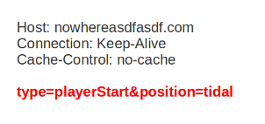
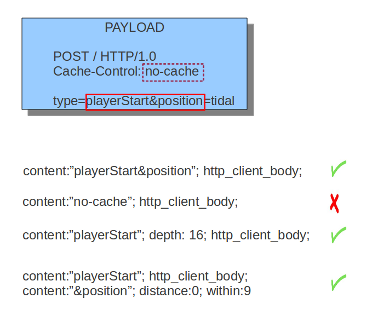
6.13.20. http.request_body
With the http.request_body content modifier, it is possible to
match specifically and only on the HTTP request body. The keyword can
be used in combination with all previously mentioned content modifiers
like distance, offset, nocase, within, etc.
Example of http.request_body in a HTTP request:
Example of the purpose of http.client_body:
Note: how much of the request/client body is inspected is controlled
in the libhtp configuration section via the request-body-limit
setting.
http.request_body replaces the previous keyword name: `http_client_body. You may continue
+to use the previous name, but it’s recommended that rules be converted to use
+the new name.
6.13.21. http.stat_code
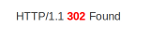
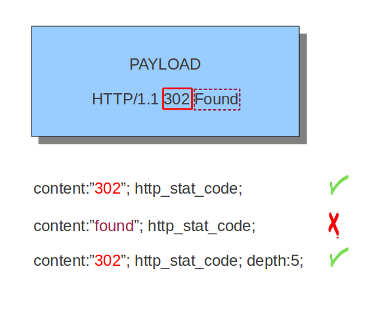
With the http.stat_code content modifier, it is possible to match
specifically and only on the HTTP status code buffer. The keyword can
be used in combination with all previously mentioned content modifiers
like distance, offset, nocase, within, etc.
Example of http.stat_code in a HTTP response:
Example of the purpose of http.stat_code:
6.13.22. http.stat_msg
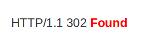
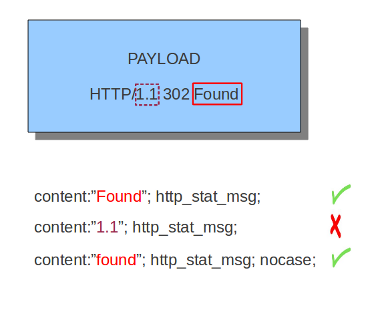
With the http.stat_msg content modifier, it is possible to match
specifically and only on the HTTP status message buffer. The keyword
can be used in combination with all previously mentioned content
modifiers like depth, distance, offset, nocase and
within.
Example of http.stat_msg in a HTTP response:
Example of the purpose of http.stat_msg:
6.13.23. http.response_line
The http.response_line forces the whole HTTP response line to be inspected.
Example:
alert http any any -> any any (http.response_line; content:"HTTP/1.0 200 OK"; sid:1;)
6.13.24. http.response_body
With the http.response_body content modifier, it is possible to
match specifically and only on the HTTP response body. The keyword can
be used in combination with all previously mentioned content modifiers
like distance, offset, nocase, within, etc.
Note: how much of the response/server body is inspected is controlled
in your libhtp configuration section via the response-body-limit
setting.
6.13.24.1. Notes
Using
http.response_bodyis similar to having content matches that come afterfile_dataexcept that it doesn’t permanently (unless reset) set the detection pointer to the beginning of the server response body. i.e. it is not a sticky buffer.http.response_bodywill match on gzip decoded data just likefile_datadoes.Since
http.response_bodymatches on a server response, it can’t be used with theto_serverorfrom_clientflow directives.Corresponding PCRE modifier:
Qfurther notes at the
file_datasection below.
http.response_body replaces the previous keyword name: `http_server_body. You may continue
+to use the previous name, but it’s recommended that rules be converted to use
+the new name.
6.13.25. http.server
Sticky buffer to match on the HTTP Server headers. Only contains the header value. The \r\n after the header are not part of the buffer.
Example:
alert http any any -> any any (flow:to_client; \
        http.server; content:"Microsoft-IIS/6.0"; sid:1;)
6.13.26. http.location
Sticky buffer to match on the HTTP Location headers. Only contains the header value. The \r\n after the header are not part of the buffer.
Example:
alert http any any -> any any (flow:to_client; \
        http.location; content:"http://www.google.com"; sid:1;)
6.13.27. http.host and http.host.raw
With the http.host content modifier, it is possible to
match specifically and only the normalized hostname.
The http.host.raw inspects the raw hostname.
The keyword can be used in combination with most of the content modifiers
like distance, offset, within, etc.
The nocase keyword is not allowed anymore. Keep in mind that you need
to specify a lowercase pattern.
6.13.27.1. Notes
http.hostdoes not contain the port associated with the host (i.e. abc.com:1234). To match on the host and port or negate a host and port usehttp.host.raw.The
http.hostandhttp.host.rawbuffers are populated from either the URI (if the full URI is present in the request like in a proxy request) or the HTTP Host header. If both are present, the URI is used.The
http.hostandhttp.host.rawbuffers will NOT include the header name, colon, or leading whitespace if populated from the Host header. i.e. they will not include “Host: “.The
http.hostandhttp.host.rawbuffers do not include a CRLF (0x0D 0x0A) at the end. If you want to match the end of the buffer, use a relative ‘isdataat’ or a PCRE (although PCRE will be worse on performance).The
http.hostbuffer is normalized to be all lower case.The content match that
http.hostapplies to must be all lower case or have thenocaseflag set.http.host.rawmatches the unnormalized buffer so matching will be case-sensitive (unlessnocaseis set).If a request contains multiple “Host” headers, the values will be concatenated in the
http.hostandhttp.host.rawbuffers, in the order seen from top to bottom, with a comma and space (”, “) between each of them.Example request:
GET /test.html HTTP/1.1
Host: ABC.com
Accept: */*
Host: efg.net
http.hostbuffer contents:abc.com, efg.net
http.host.rawbuffer contents:ABC.com, efg.net
Corresponding PCRE modifier (
http_host):WCorresponding PCRE modifier (
http_raw_host):Z
6.13.28. file_data
With file_data, the HTTP response body is inspected, just like
with http.response_body. The file_data keyword is a sticky buffer.
Example:
alert http any any -> any any (file_data; content:"abc"; content:"xyz";)
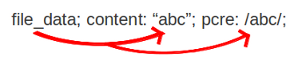
The file_data keyword affects all following content matches, until
the pkt_data keyword is encountered or it reaches the end of the
rule. This makes it a useful shortcut for applying many content
matches to the HTTP response body, eliminating the need to modify each
content match individually.
As the body of a HTTP response can be very large, it is inspected in smaller chunks.
How much of the response/server body is inspected is controlled
in your libhtp configuration section via the response-body-limit
setting.
If the HTTP body is a flash file compressed with ‘deflate’ or ‘lzma’,
it can be decompressed and file_data can match on the decompress data.
Flash decompression must be enabled under libhtp configuration:
# Decompress SWF files.
# 2 types: 'deflate', 'lzma', 'both' will decompress deflate and lzma
# compress-depth:
# Specifies the maximum amount of data to decompress,
# set 0 for unlimited.
# decompress-depth:
# Specifies the maximum amount of decompressed data to obtain,
# set 0 for unlimited.
swf-decompression:
  enabled: yes
  type: both
  compress-depth: 0
  decompress-depth: 0
6.13.28.1. Notes
If a HTTP body is using gzip or deflate,
file_datawill match on the decompressed data.Negated matching is affected by the chunked inspection. E.g. ‘content:!”<html”;’ could not match on the first chunk, but would then possibly match on the 2nd. To avoid this, use a depth setting. The depth setting takes the body size into account. Assuming that the
response-body-minimal-inspect-sizeis bigger than 1k, ‘content:!”<html”; depth:1024;’ can only match if the pattern ‘<html’ is absent from the first inspected chunk.file_datacan also be used with SMTP